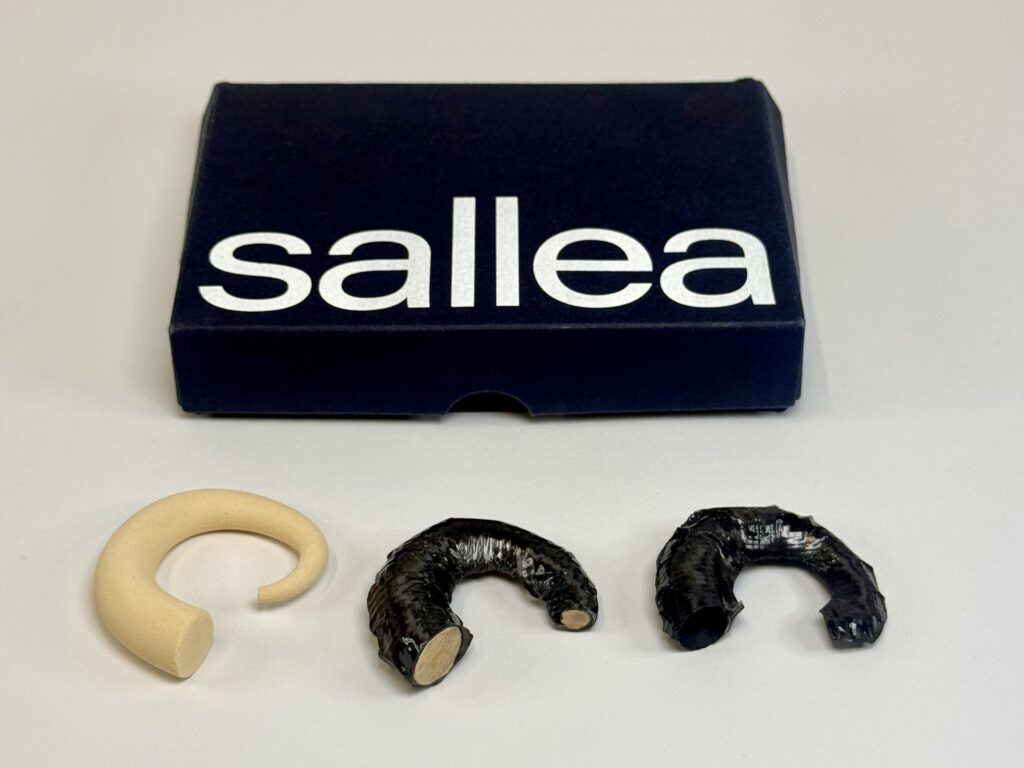
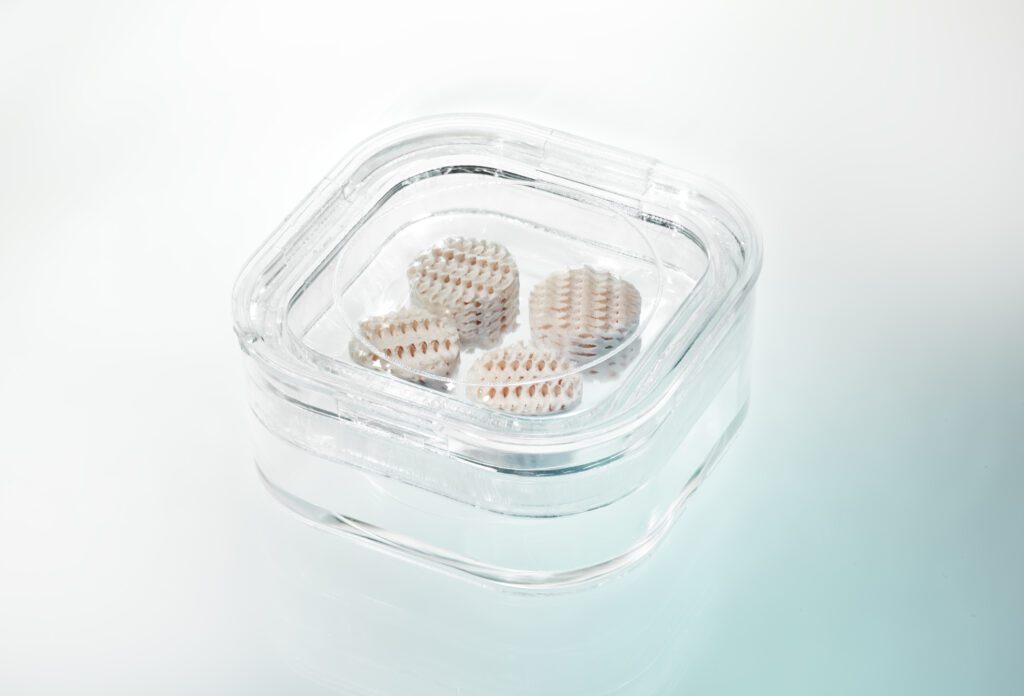
Sallea, an ETH Zurich spin-off specializing in templating technologies for biomanufacturing, is expanding the application of its proprietary salt-based structuring platform into the field of advanced composites and high-performance materials manufacturing.
At the core of Sallea’s technology is the controlled shaping of water-soluble salt cores, which act as temporary templates during manufacturing. These cores enable the creation of complex internal geometries and cavities that are difficult to realize with conventional tooling approaches. Following part consolidation, the salt is removed through dissolution, leaving behind precisely defined internal structures without the need for permanent cores or complex demoulding strategies.
Originally developed for applications in biomanufacturing, this templating approach is now being evaluated for composite processes where geometric complexity, weight reduction and process integration are key performance drivers. The technology is compatible with a range of manufacturing routes, including liquid moulding processes such as RTM, as well as thermoplastic processing approaches involving co-moulding or overmoulding.
Compared to traditional core materials such as foams, honeycombs or sacrificial mandrels, salt-based templates offer a distinct combination of design freedom and process robustness. The cores can withstand typical processing conditions while enabling the integration of internal features such as channels, lattice structures or functional cavities. This opens up new possibilities for monolithic part design, reducing the need for secondary bonding operations and enabling more efficient load path-oriented structures.
From a manufacturing perspective, the approach also contributes to process simplification and material efficiency. By enabling more integrated geometries, it can reduce the number of components and assembly steps. In addition, the use of salt as a templating material introduces advantages in terms of sustainability, given its abundance, low cost and potential for reuse in closed-loop systems.
As industries such as aerospace, mobility and industrial equipment continue to push towards lightweight, high-performance and more sustainable structures, such templating technologies could play an important role in enabling next-generation composite architectures.
Call for Industry Collaboration
As Sallea continues to develop and scale its technology for composite applications, the company is actively engaging with industry experts, manufacturers and potential partners to better understand current challenges and requirements.
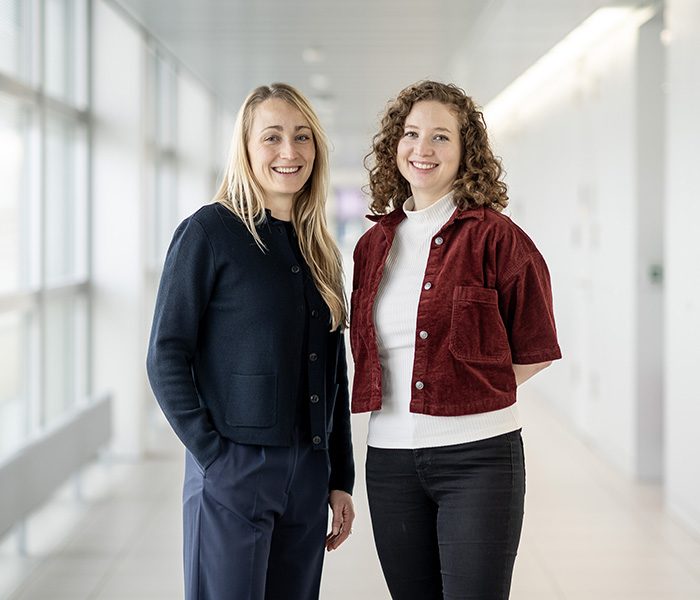
“At Sallea, we developed a platform technology that enables the structuring of materials into high-performance parts. Our salt-cores allow manufacturers to create complex lightweight structures while enabling more efficient and sustainable production processes.”, Simona Fehlmann, CEO and co-founder, Sallea
To support this effort, Sallea has launched a short survey (3–5 minutes) aimed at gathering insights on manufacturing challenges, market needs and opportunities for innovation.
All responses will be treated confidentially and used only in aggregated form.
“Your feedback will help guide our technology development and ensure we are addressing real industry needs.”
About Sallea
Sallea is an ETH Zurich spin-off developing templating technologies for structuring materials into high-performance components. Initially focused on biomanufacturing, the company is now extending its platform to industrial applications, including advanced composites, with the ambition to enable complex geometries, lightweight structures and scalable manufacturing solutions.
21.03.2026
-
28.03.2026
MAI Carbon
Delegationsreise unter Leitung von Staatssekretär Tobias Gotthardt nach Mexiko - Shaping the Future of Industry and Infrastructure
24.03.2026
-
25.03.2026
CU
CU West
MAI Carbon
Fachforum "Werkstoffe im Dialog: Biocomposites & CFK zwischen Chancen und Praxis"
26.03.2026
-
26.03.2026
CU
CU BW
11. Fachveranstaltung Composite Simulation – Online Compact
14.04.2026
-
15.04.2026
CU
CU Nord
CU Innovation Lab "Intelligent Composite Production"
15.04.2026
CU
Weiterbildung
Webseminar Wednesday: CO2-Footprint und Resilienz – Wie lassen sich Lieferketten bewerten?
16.04.2026
CU
CU Nord
CU Ost
Sitzung der AG "Sustainability": Von CSRD zu LCA: Einblicke in Methoden, Daten und Software
20.04.2026
CU
CU West
39. Jour Fixe "Mehr Effizienz durch Automation, digitale Zwillinge und Machine Learning?"
21.04.2026
CU
7. Lightweighting Summit "Vorsprung durch Effizienz"
21.04.2026
CU
MAI Carbon
Symposium "Shaping Tomorrow: Automatisierung. Robotik. Humanoide.“
22.04.2026
-
22.04.2026
CU
Sitzung der AG Digitalisierung gemeinsam mit dem AVK
23.04.2026
CU
Weiterbildung
Online-Weiterbildung: Faserverbundwerkstoffe in der Praxis - Werkstoffe, Konstruktion und Verarbeitung
29.04.2026
CU
CU Ost
CU Ost Unternehmer-Stammtisch "Wissenschaft trifft Wirtschaft bei white IP"
29.04.2026
CU
Weiterbildung
Webseminar Wednesday: Pushing the Limits – Talentstrategien in der Composites Industrie
05.05.2026
-
06.05.2026
CU
CU Ost
4. Internationale Faserverbund-Sandwich-Tagung
05.05.2026
-
07.05.2026
CU
CU Austria
MAI Carbon
MAI Business Tour und CU Innovation Day "Lightweight Experience - Composites für Mobilität, Aerospace & Sport"
07.05.2026
CU
Weiterbildung
Online-Weiterbildung: Faserverbundwerkstoffe in der Praxis – Grundlagen der Mechanik und Modellierung
07.05.2026
CU
Sitzung der CU-AG "Leichtbau für Wasserstoffsysteme" und des AVK-AK "Wasserstoff-Drucktanks"
18.05.2026
-
20.05.2026
CU
CU Bau
MAI Carbon
2. Fachforum CrossConnect: Verbundwerkstoffe aus Holz, Carbon & Co. als Treiber für ein zukunftsgewandtes Bauwesen
18.05.2026
CU
CU West
40. Jour Fixe "Neue EU-Aufrufe für Verbundwerkstoffe - Chancen für KMU?"
20.05.2026
-
21.05.2026
CU
CU Nord
Composites Innovation Event 3rd Edition: New Frontiers for Composites in Extreme Environments
21.05.2026
CU
Weiterbildung
Online-Weiterbildung: Textile Verstärkungsstrukturen für Faserverbundwerkstoffe – kompakt
17.06.2026
CU
CU Nord
CU Ost
Sitzung der AG "Sustainability" - Basisworkshop LCA
18.06.2026
-
19.06.2026
CU
CU Ost
29. Internationales Dresdner Leichtbausymposium
25.06.2026
CU
Weiterbildung
Weiterbildung: Basiswissen der Faserverbundfertigung - qualitätsgerechte Fertigung, Schadensvermeidung, Arbeitsschutz
19.08.2026
CU
CU Bau
CU Ost
Sommergrillen von CU Ost und CU Bau
16.09.2026
CU
CU West
CU West Mitgliederversammlung & Jubiläumsfeier
20.10.2026
-
21.10.2026
Ceramic Composites
CU
CU Austria
CU Bau
CU BW
CU Nord
CU Ost
CU Switzerland
CU West
MAI Carbon
JEC Forum DACH 2026
20.10.2026
-
22.10.2026
CU
AIRTEC
28.10.2026
-
29.10.2026
Ceramic Composites
CU
CU Austria
CU Bau
CU BW
CU Nord
CU Ost
CU Switzerland
CU West
MAI Carbon
ITHEC - International Conference and Exhibition on Thermoplastic Composites
05.11.2026
CU
CU BW
Technologietag Leichtbau 2026
Bei Fragen, Anregungen und Hinweisen zu unseren Leistungen, der Website oder sonstigen Anliegen stehen wir Ihnen gerne zur Verfügung. Schreiben Sie uns.











Unser kostenfreier Info-Newsletter informiert monatlich über Neuigkeiten aus dem CU, Veranstaltungen, Stellenangebote unserer Mitglieder und vieles mehr.

Composites United e.V. ist ein Verbund von Unternehmen und Forschungseinrichtungen, der die gesamte Wertschöpfungskette für faserbasierten multimaterialen Leichtbau in Deutschland, Österreich und der Schweiz abdeckt. Dazu kommen internationale Vertretungen in Japan, Süd-Korea, China und Indien.
