Highly integrated thermoplastic organoplates from recycled material for the aviation industry

The aviation research HIOS project exemplarily demonstrated the potential use of recycled carbon fibers in aviation. It aimed at developing series-compatible processes for the production of highly integrated composite semi-finished products.

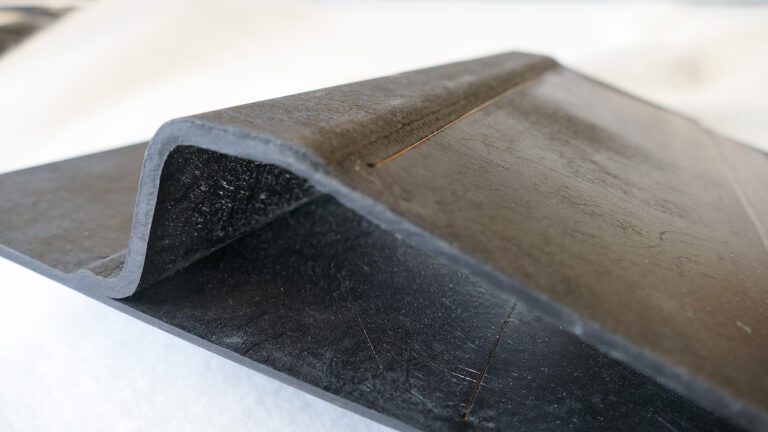
Inspired by Daedalus, the old Greek inventor of flying, the the HIOS project was set to create sustainable applications in aviation. Experts from the STFI Saxon Textile Research Institute and the Fiber Institute Bremen (FIBRE) jointly explored new ways by transforming waste materials such as recycled carbon fibers (rCF) into usable thermoplastic composite materials. rCF in nonwoven-based semi-finished products open new design and layout potential for components, impress with shorter consolidation times and good draping properties. In the now completed HIOS project, the entire production chain (fig. 1) for such a component was demonstrated at an example spoiler segment (fig. 2).

Fig. 1: Full production chain in HIOS

Daidalos 2.0

The STFI developed a hybrid nonwoven fabric made of rCF and thermoplastic fibers, manufactured at FIBRE. This serves as a flat semi-finished product that can be used for the downstream functionalization TFP and AFP processes. In accordance with the requirements for the final box structure, the nonwoven fabric was specifically reinforced locally, functionalized with TFP structures, and consolidated into organo sheets in a single process. So organo sheets with variable thicknesses at production speeds of up to 20 m/h could be produced.

Fig. 2: Microscopic and macroscopic demonstrator setup

How it works

The two-stage thermoforming process is based on two organo sheets. First, the lower segment of the spoiler, a stepped organic sheet (2 – 6 mm wall thickness), is heated in an IR field and formed. After consolidation, the box structure (fig. 3) is manufactured in a connected pressing cycle. The second flat organo sheet (3 mm wall thickness) for the upper shell of the spoiler is also heated and fed to the press. Meanwhile, the joining zone of the lower segment is also heated locally. The process can be described as co-consolidation with local heating of the joining areas.
The mold temperature remains constant throughout the entire process in order to save energy costs. Process times of app. 15 minutes have been demonstrated for this.

The research results show the potential for series production, which is why the project partners will push ahead with further development in this field.
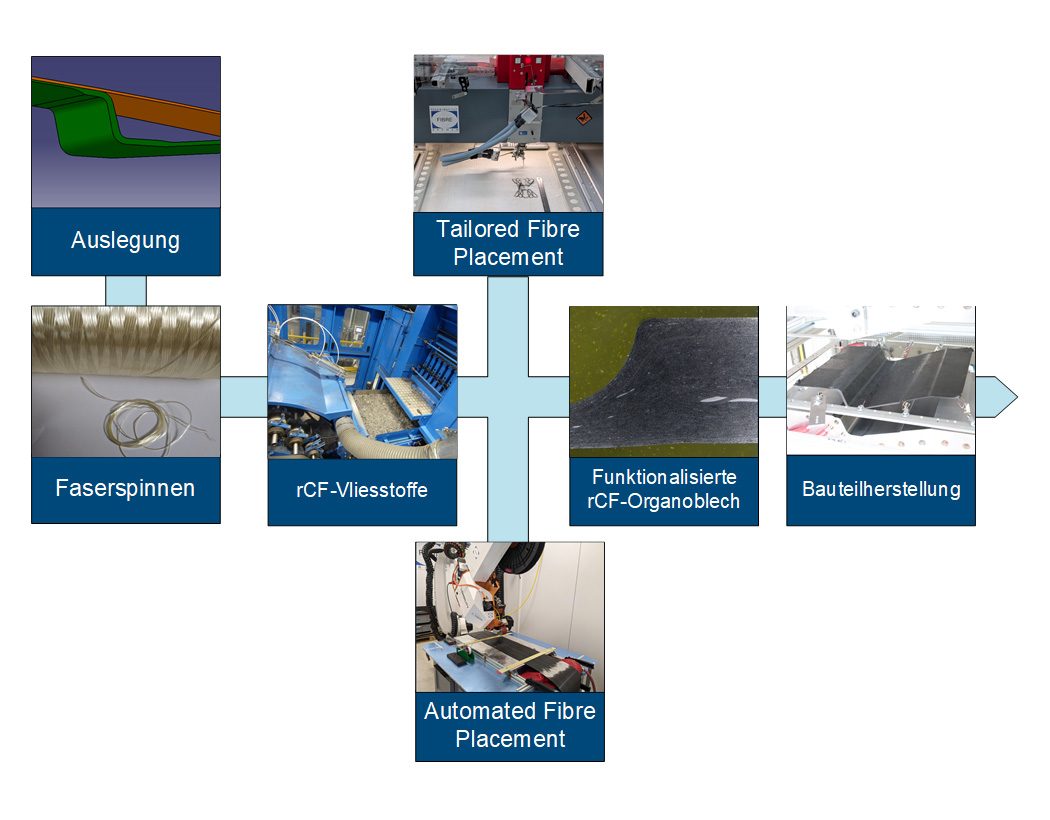
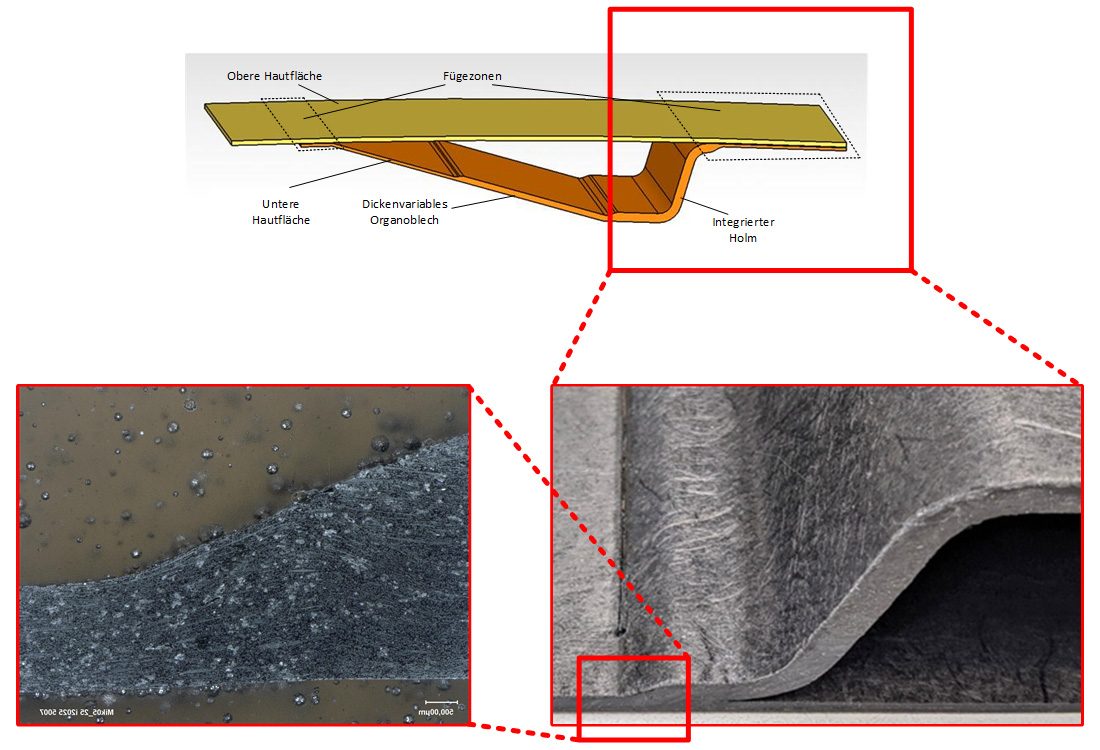
Fig. 3: Implemented spoiler segment

Contact:

Sächsisches Textilforschungsinstitut e. V. 
Dipl.-Ing. Katrin Jobke
+49 371 52 74-253
katrin.jobke@stfi.de
www.stfi.de

FIBRE Faserinstitut Bremen e. V. 
Dipl.-Ing. Richard Vocke
+49 421 218-596 68
vocke@faserinstitut.de
www.faserinstitut.de