Significantly lighter commercial vehicles through inverse hybrid laminates
The use of inverse hybrid laminates has successfully replaced the conventional steel side walls of battery carriers for commercial vehicles. The new lightweight solution, which specifically uses and combines different layer structures, reduces the weight of the individual component by around 70 % and that of the entire assembly by over 30 %.
In addition to electric mobility in the private sector, another essential part of the future global mobility strategy will be the switch to electric drives in the commercial vehicle sector. Here, due to the higher total weight of the electric vehicles’ batteries, weight reduction in structural components will be particularly important.
Practical implementation
Thermoset and thermoplastic composites with continuous carbon fibers or continuous glass fibers offer considerable potential for use in the automotive sector due to their high strength and stiffness. Thermoplastic composites also allow significantly shorter processing and forming times than thermoset systems.
Glass fiber and carbon fiber reinforced components based on polyamide 6 have already been tested in series production. In collaboration with the Luxembourg Institute of Science and Technology, Riga Technical University, and FORD Otosan Türkiye, the Cluster of Excellence MERGE at Chemnitz University of Technology has now replaced the steel side walls previously used in battery carriers in the commercial vehicle industry with a thermoplastic inverse hybrid laminate.
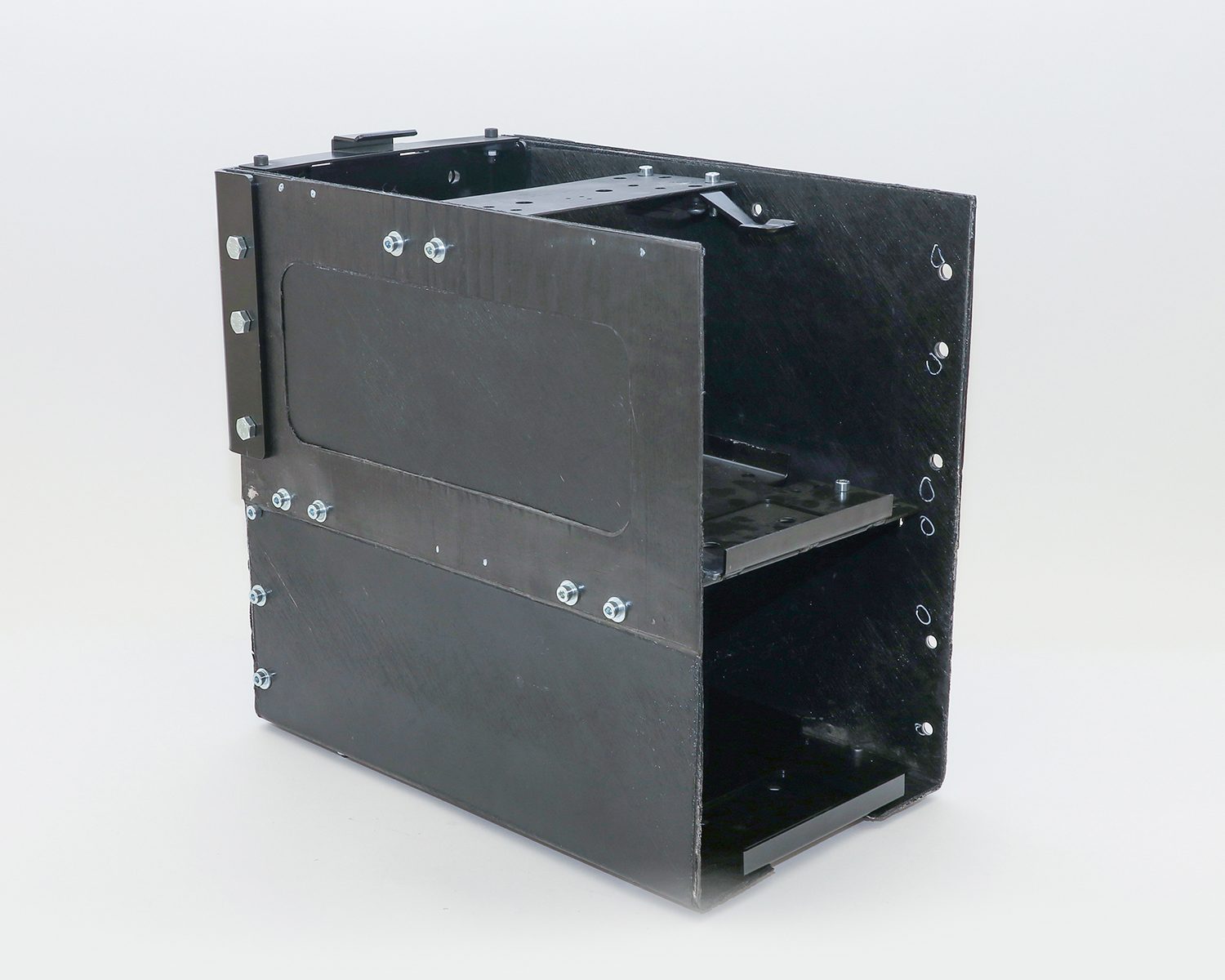
Light and save: battery carrier made of inverse hybrid laminates (© TUC)
Sophisticated manufacturing technology
This successful replacement by a complex arrangement of several layers and different material systems was based on a preceding FEM analysis. As its central metal component the inverse hybrid laminate uses the aluminum alloy EN AW-6082-T6. On both sides, an adhesive film based on polyamide/polypropylene ensures reliable adhesion between the aluminum alloy and the composite materials. Unidirectional glass fiber tapes with a polyamide-6 matrix are applied
on each side in different fiber orientations. In addition, a reinforcement frame made of unidirectional carbon fiber tapes with a polyamide-6 matrix is applied to one side, with the fibers arranged alternately in 0° and 90° orientations. As a semi-finished product, the inverse hybrid laminate was then formed and consolidated into a component side wall in a single manufacturing step. The pressing was carried out on a high-temperature press (Wickert WKP 3000 S) with integrated induction heating and cooling system to minimize process times.
In the first manufacturing process step, the individual layers are cut to preferred size by a laser cutting machine, then the entire hybrid structure is preheated. The layer package is consolidated at a defined pressing process temperature and a specified pressing pressure. The built-in cooling system immediately monitors the temperature of the pressed component to room temperature. In the final manufacturing step, the necessary holes for assembling the end product are made by water jet cutting.
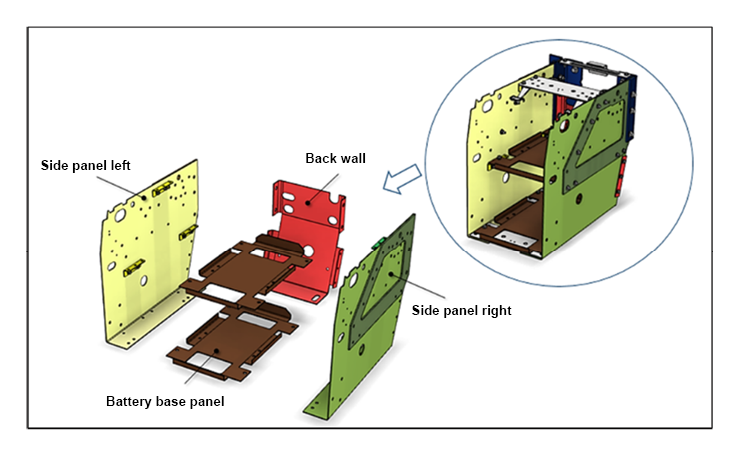
Design of the novel lightweight carrier (© TUC)
Contact:
University of Technlogy Chemnitz, Cluster of Excellence MERGE
Dipl.-Ing. (BA) Jens Bartelt, Research assistant
+49 371 531-366 61
jens.bartelt@mb.tu-chemnitz.de
Dr.-Ing. Camilo Zopp, CEO
www.tu-chemnitz.de/MERGE/