Members support all strategic decisions – Record interest in the executive committee election underscores the confidence of the members and the importance of the association
The 7th Ordinary members’ meeting of Composites United e. V. (CU) on November 13, 2025, at the Augsburg Technology Center marked an important step in the further development of the association. The focus was on strategic market analyses, political successes, international cooperation, and the operational and substantive performance of CU. All resolutions – including amendments to the articles of association and the 2026 budget – were met with broad approval. The high number of candidates for the executive committee also highlighted the strong interest of members in actively shaping the association.
The meeting highlighted the extent to which technological, economic, and political factors influence the fiber composites industry. The welcome address by Prof. Dr. Klaus Drechsler (Fraunhofer IGCV; Technical University of Munich and spokesperson for the CU Executive Committee) and CU CEO Dr. Tjark von Reden set the stage for a review of a year that was marked above all by global shifts in competition, new regulatory requirements, and more intensive international cooperation.
Presidium report: Global competitive dynamics and political decisions
Prof. Dr. Klaus Drechsler analyzed the central challenge facing the industry: the rapid expansion of carbon fiber production in China, which now accounts for around 40% of global capacity. This puts considerable pressure on Europe to act, particularly with regard to industrial sovereignty and securing its own production capacities. The CU therefore continues to be active at the political level to highlight the strategic importance of carbon fibers and secure production in Europe. In addition, the recycling of carbon fibers remains a focus of the CU’s political work in order to close the material cycle.
The association has once again achieved success at the political level. The relaxation of the EU’s End-of-Life Vehicles Directive, which removed carbon fibers from the list of potentially hazardous substances, prevents restrictions in the automotive sector. The anchoring of lightweight construction in the coalition agreement and the continuation of the Lightweight Design Office strengthen the funding landscape for innovations and industrial projects.
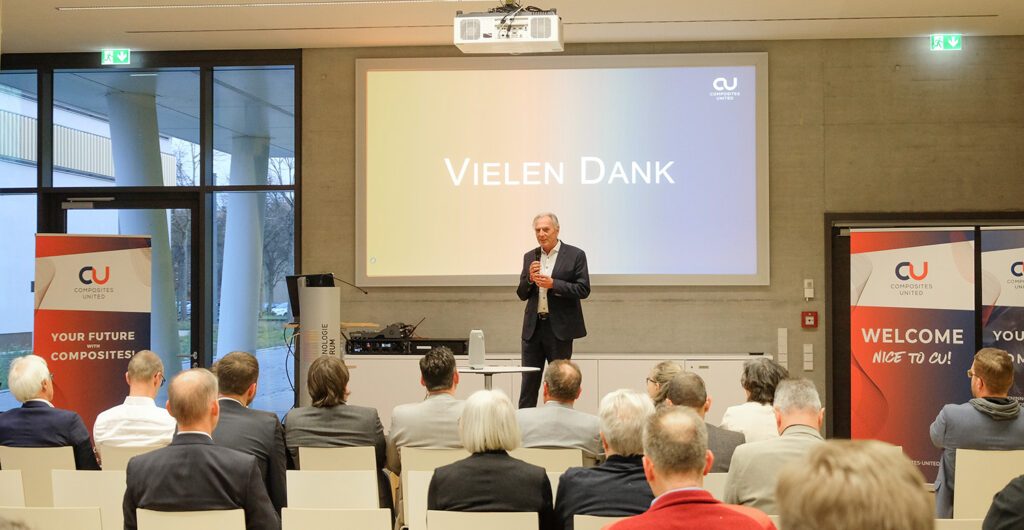
Prof. Dr. Klaus Drechsler (Fraunhofer IGCV; Technical University of Munich and spokesperson for the CU Executive Committee) reported on current market developments, lobbying activities, and the CU’s international relations.
In addition, the CU has further expanded its international relations. Cooperation with the Swedish network LIGHTer, collaboration with partners in Korea and Japan, and joint formats with CompositesNL and AEMAC create additional opportunities for innovation and market access. The business development trip to Japan, with strong participation from CU members, demonstrated how economically relevant this international networking has become.
Report from the General Management: Operational strength and a clear focus on the future
CEO Dr. Tjark von Reden emphasized that CU is also very well positioned operationally. The membership base remains stable and continues to represent a broad spectrum of the industry. The year 2025 was marked by intense activity: with around 40 in-person and 50 online events and over 3,700 participants, the association confirmed its role as a central platform for exchange, knowledge transfer, and networking.
A particular focus was on international visibility. The large joint stand at JEC World 2026 in Paris will once again offer members an attractive platform to present themselves at the world’s most important industry gathering and gain access to international markets.
At the same time, communication efforts were further strengthened. The growing reach on social media, the established member magazine, and various podcast formats are helping to raise the profile of the network’s topics, companies, and research results.
Promoting young talent and training also remain central components of the association’s work. The long-standing trainee program, diverse continuing education offerings, STEM activities, and student programs support the development of future skilled workers. Projects such as DigiPass, ResC4EU, and syntral also address key future topics such as digitalization, sustainability, and supply chain resilience, and generate important innovation impulses for the industry.
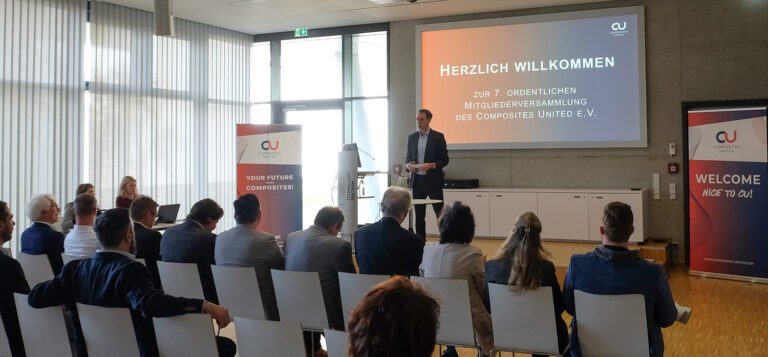
CU CEO Dr. Tjark von Reden reported on membership development, events, projects, and continuing education offerings at the CU.
Executive committee election: Broad expertise and new chair
The election of the new executive committee was a highlight of the meeting. Sixteen candidates ran for eight seats. The high level of participation demonstrates the willingness of member organizations to take on responsibility and participate in strategic planning. This is an important signal with regard to the coming years, in which global challenges and transformation processes will continue to gain momentum.
The following were elected:
- Marc Fette (CTC – Composite Technology Center GmbH)
- Prof. Dr. Frank Henning (Fraunhofer ICT)
- Dr. Heike Illing-Günther (STFI)
- Dr. Gernot Kalkoffen (Carbon Truck & Trailer GmbH)
- Dr. Steffen Kress (Mubea Aviation GmbH)
- Dr. Hauke Lengsfeld (Mitsubishi Chemical Advanced Materials GmbH)
- Prof. Dr. Jens Ridzewski (IMA Materialforschung und Anwendungstechnik GmbH)
- Kai Steinbach (Hightex Verstärkungsstrukturen GmbH)
Prof. Dr. Klaus Drechsler, long-standing spokesperson for the executive committee, did not stand for re-election. He has had a decisive influence on the development of the CU for eighteen years and will fortunately remain active in the network. Following the election, Marc Fette was elected as the new spokesperson for the executive committee.
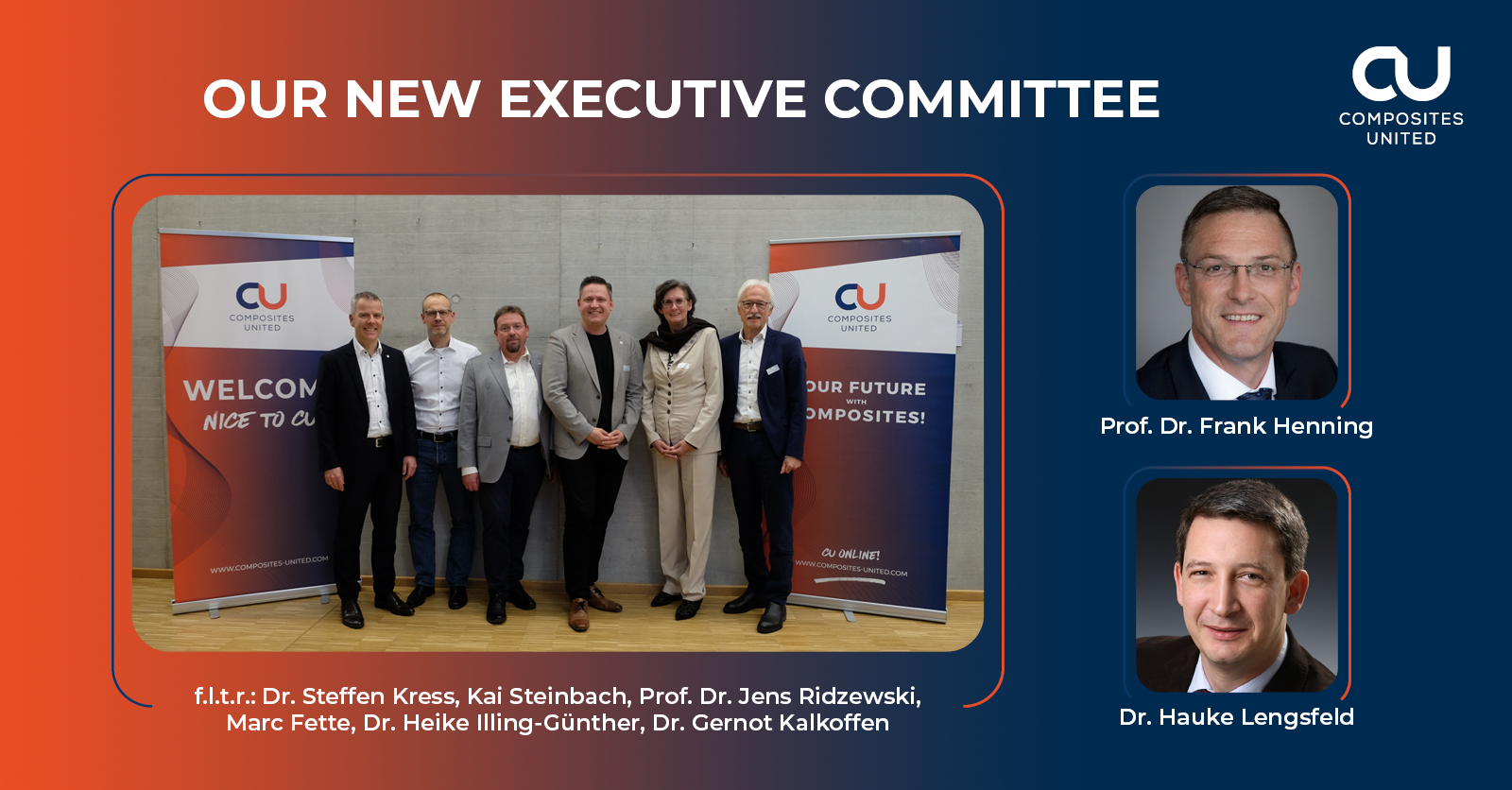
Over the next three years, the new team will focus on key strategic issues: the international positioning of European lightweight design, securing reliable value-added structures, opening up new markets, and promoting technological innovations along the entire composites value chain.
An association that actively shapes its role
This year’s members’ meeting showed that the CU is excellently positioned both strategically and organizationally. The challenges facing the industry—from global competitive dynamics and political conditions to technological upheavals—require clear positioning and reliable representation of interests. In 2025, the CU provided important impetus, achieved political successes, and significantly strengthened its international network. With its newly elected executive committee and a strong operational office, the association is well prepared to play a decisive role in shaping the future of European lightweight design.