The winners of the prestigious Innovation Award for Fibre-Reinforced Plastics from the AVK – the German Federation of Reinforced Plastics, were announced this year on October 21st, 2025, at the JEC Forum DACH in Dresden.
The award goes to companies, institutes and their partners in the three categories “Products and Applications”, “Processes and Procedures” and “Research and Science” for outstanding composites innovations. A jury of experts consisting of engineers, scientists and trade journalists evaluates the submissions in the three categories based on criteria such as degree of innovation, degree of implementation and sustainability.
Category Innovative Products and Applications
Place 1 | Zeisberg Carbon GmbH
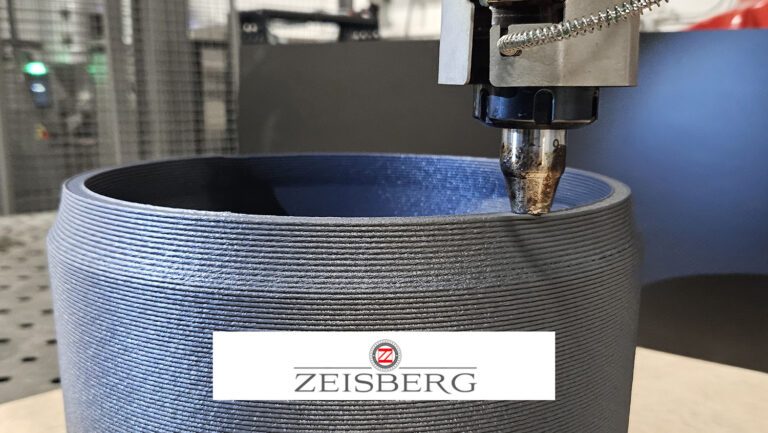
3D-Formwork® – The 3D-printed concrete formwork, manufactured using Germany’s largest 3D printer for thermoplastics
Technological development in the field of automation is in full swing and forms the basis of many value chains – and now, with 3D Formwork®, in the construction industry too.
Germany’s largest 3D printer for fibre-reinforced thermoplastics, built by Zeisberg Carbon GmbH, produces laminating tools measuring up to 6,000 mm x 2,000 mm x 3,000 mm, finished components, prototypes and – as a new approach to the Industry 4.0 concept in the construction industry – moulds for the production of concrete components. Formwork and matrices are printed automatically, layer by layer, from recycled plastic. This enables a high degree of innovation despite demographic change, in prefabricated component factories or in in-situ concrete construction.
Architectural freedom can be reimagined: 3D-Formwork® creates individual façade elements for serially manufactured buildings, such as bridges. In keeping with the spirit of the times, infrastructure can thus be built quickly and yet aesthetically.
Place 2 | INVENT GmbH
Partner: Nord-Micro GmbH • KOHPA GmbH
Carbon Heating System ‘CHS’ for aircraft cabins
INVENT has developed an innovative Carbon Heating System (CHS) for aircraft: heating function integrated directly into fibre composite pipes – based on conductive carbon fibres. All development steps, including endurance testing (>3300 h) and DO-160 qualification by the laboratories of our partner Nord-Micro, have been completed. The system replaces conventional metal heaters or bleed air heating, saving weight, fuel and emissions by using the existing cabin air distribution system. Passengers benefit from clean air without oil contamination. INVENT is ready as a series manufacturer – Nord-Micro is looking for partners for the maiden flight. CHS is a milestone for electric cabin systems and sustainable aircraft architecture.
Place 3 | 3D|CORE GmbH & Co. KG
3D|CORE FR SealingTM: A polymer-mineral foam for improved fire protection in lightweight structures, with integrated high-performance insulation
3D|CORE GmbH & Co. KG, a specialist in lightweight construction, is launching 3D|CORE FR Sealing™, an innovative fire protection foam. The product offers an efficient, cost-effective and weight-saving solution for fire protection in lightweight structures, particularly in the transport industry. Until now, fire protection for sandwich constructions used in trains, ships and vehicles has been very costly. It required the manual application of additional glass fibre layers and the use of additional quantities of fire-modified resins, which significantly increased the manufacturing costs and weight of the components and contradicted the basic idea of lightweight construction.
3D|CORE has solved this problem with 3D|CORE FR Sealing™, a closed-cell polymer-mineral foam that is easily applied by spraying or rolling. The system provides effective protection against fire without adding unnecessary weight to the component.
The new foam has been extensively tested and has achieved outstanding results. It meets the stringent requirements of the IMO FTP Code 2010 maritime standards and the European standard for rail vehicles EN 45545-2, achieving the requirements of the highest hazard level HL3. The two-component system consists of a medium-viscosity foam and an activator that controls the processing time. Chemical reactions and delamination are avoided by precisely matching the polymer components to the resin system of the component.
3D|CORE FR Sealing™ is a technical improvement for fire protection and also a sustainable and economical alternative. It reduces material consumption and lowers the overall weight of components, making it an ideal solution for modern, future-oriented applications.
Category Innovative Processes and Procedures
Place 1 | SECARA
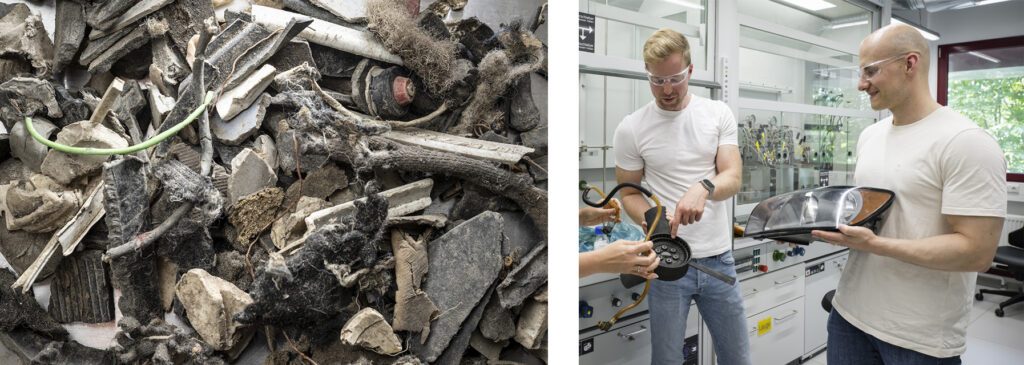
Innovative chemical recycling for reinforced engineering polymers
SECARA has developed a process that, for the first time, enables technical plastics such as polyamides, polycarbonates and polyesters such as PBT to be recycled efficiently and with minimal loss of value. With a global annual production of around 15 million tonnes, these key materials have previously ended up almost entirely in incinerators due to a lack of recycling options.
SECARA’s scalable process also enables the recycling of old, glass fibre-reinforced and mixed plastic waste. Pilot plants are already demonstrating how polymers can be depolymerised into high-purity monomers. These are chemically identical to fossil raw materials and can be seamlessly integrated into existing value chains. The process already saves up to 70 % in CO₂ emissions. Using renewable energies, it is even possible to produce completely decarbonised monomers. Together with leading industry partners, SECARA is now scaling up the technology towards a pilot plant – a contribution to decarbonisation and to strengthening European supply chains.
SECARA is funded by the Federal Ministry for Economic Affairs and Energy and the European Social Fund as part of the EXIST program.
Place 2 | Leibniz-Institut für Polymerforschung Dresden e. V. (IPF)
Partner: Elbflorace Formula Student Team TU Dresden e. V. (FS)
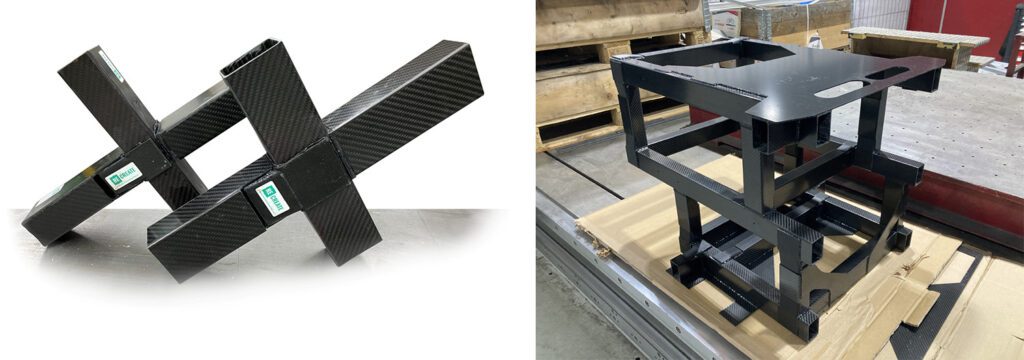
Development of a process for designing and manufacturing a spatial CFRP structural frame based on flat TFP preforms, using the example of a wishbone bracket for a Formula Student vehicle
In collaboration between the IPF and the FS team, a complex, high-load 3D structural framework made of carbon was produced for the first time using the Tailored Fibre Placement (TFP) process. A topology-optimised, additively manufactured titanium wishbone bracket served as a reference. Based on the corresponding installation space and the specifications, topology optimisation and segmentation were first carried out.
The TFP process allows the reinforcement fibres to be deposited variably axially, enabling spatial optimisation of fibre positioning and alignment for the first time. This means that an optimised fibre placement pattern can be created for each segment and manufactured using a TFP system. After consolidating the preforms in a multi-part silicone mould, a CFRP wishbone bracket with a mass of only 183 g was produced. This is around 40 % lighter than the titanium component and can still safely transmit loads of up to 5 kN.
Place 3 | Amiblu Germany GmbH
Recycling of GRP – grinding dust waste
At its Trollenhagen site, the company manufactures around 300 kilometres of GRP pipes per year in nominal diameters ranging from DN 200 to DN 2450 using the centrifugal casting process. This process produces grinding dust as a waste product. With the help of a technology developed in-house, it is now possible to return over 90 % of these approximately 220 tonnes of grinding dust per year to the production process. This saves raw materials and reduces waste disposal costs.
The plant has been in series operation since summer 2024 and is unique on the market. The process not only significantly reduces waste, but also saves around 4 % of the raw material calcium carbonate. The advantages: conserving resources, avoiding waste and recycling into new products are a significant step towards sustainable pipe production.
Category Science and Research
Place 1 | EDAG Engineering GmbH
Partner: Invent GmbH • Fraunhofer IWU • Applus+ Rescoll
Durable and detachable fibre composite structures for the circular economy
The EU Recreate project has developed a modular system that enables the circular use of CFRP structures for the first time. Its core components are thermally detachable adhesive bonds that allow components to be separated without damage by applying specific temperatures – without compromising strength during operation. Combined with standardised profiles and connecting elements, this creates a modular system that enables repair, reuse, remanufacturing and single-type recycling. Through the practical implementation of design for circularity, the solution addresses key strategies of the circular economy. At the same time, it creates a basis for new business models – from modular vehicle frames to industrial secondary uses.
Place 2 | Fraunhofer Institut für Produktionstechnologie IPT
Tape-REx – An innovative recycling process for thermoplastic UD tapes
The Fraunhofer Institute for Production Technology IPT has developed a recycling technology that allows components made of thermoplastic UD tape to be unwound at the end of their life cycle. What makes this technology unique is that the recovered recyclate is available as unidirectional tape.
The fibre length and orientation as well as the matrix are retained. These properties represent an enormous improvement over conventional recycled products, in which the fibres are generally recovered as disordered short or long fibres. The recycled unidirectional tapes can be processed in conventional manufacturing processes such as ATL/AFP and hot pressing in the same way as new tapes.
Place 3 | Faserinstitut Bremen e.V. (FIBRE) • Sächsisches Textilforschungsinstitut e.V. (STFI)
Development of highly integrated organo sheets based on hybrid rCF nonwovens with associated thermoforming process for aerospace structures with final contour
Global climate targets are driving the development of sustainable processes and products. In the LuFo VI-2 project Highly Integrated Organic Sheets (HIOS) FKZ: 20E2116A; 20E2116, FIBRE and its project partner STFI developed a resource-efficient process chain from semi-finished products to components with a closed box structure, local reinforcements and variable thickness. A spoiler segment served as an example. STFI developed a quasi-continuous interval hot pressing process for manufacturing organo sheets with variable local thickness based on nonwovens made from recycled carbon fibres. Local reinforcements were integrated during the manufacturing process. FIBRE developed a complementary thermoforming process, including tools, that allows the closed box structures to be manufactured in a resource-efficient manner. To this end, thermoforming and joining of the components were integrated into a single process step.
Contact:
Katharina Wagner
+49 (0) 69 / 27 10 77 – 13
Katharina.wagner@avk-tv.de