The research project “Partially flowable textile constructions for 3D-EPV-FKV” involves the structural development of partially flowable textile constructions and the development of processes for manufacturing shell structures with jointless structurally integrated connecting elements and load path-oriented fiber alignment.
Composite materials can consist of a variety of materials such as metals, polymers, ceramics, or fiber composites and can be joined using welding, soldering, screwing, or gluing. With the increasing prevalence of multi-component systems, there is a growing need for load-bearing solutions for efficient load transfer, especially when connecting fiber-reinforced plastics (FRP) with other materials. This is because process-related mechanical, thermal or chemical effects can damage FRP structures and cause problems such as force flow interruptions, differences in stiffness, inhomogeneity, and stress peaks, which can lead to premature failure of the FRP.
For this reason, the project introduced here focuses on structural and process development to establish innovative lightweight design methods based on shells with joint-free, structurally integrated connecting elements with load path-oriented fiber alignment (3D-EPV-FKV).
Structural development
The structural development includes carding, drawing and tailored fiber placement (TFP) technologies already established at ITM to design a flowable and stress-resistant 2D fiber structure. The fiber structures are based on thermoplastic hybrid staple fiber yarns with recycled carbon fibers (rCF-TP). To investigate the flowability of molten rCF-TP hybrid staple fiber yarns and thus enable producing complex structures, such as structurally integrated connecting elements, fiber volume fractions of 30 – 65 vol. % and fiber lengths of 30 – 100 mm are varied.
Process development
In contrast to the usual multi-stage processes, the connecting elements are manufactured in a single-stage process using ITM’s patented FiberFlowForming process. It combines extrusion with thermoforming: the flow movement of the molten thermoplastic matrix shapes the recycled carbon fibers of the hybrid staple fiber yarns under pressure into the mold cavities.
The use of staple fibers requires research into the controlled adjustment of fiber volume fraction, fiber orientation, and fiber position. This is to achieve a specific alignment of the rCF in the cavity and thus optimize the properties of the FRP. The result is FRP structures in which the staple fibers run uninterrupted from the shell to the connecting element in line with the load path, thus enabling efficient load transfer.
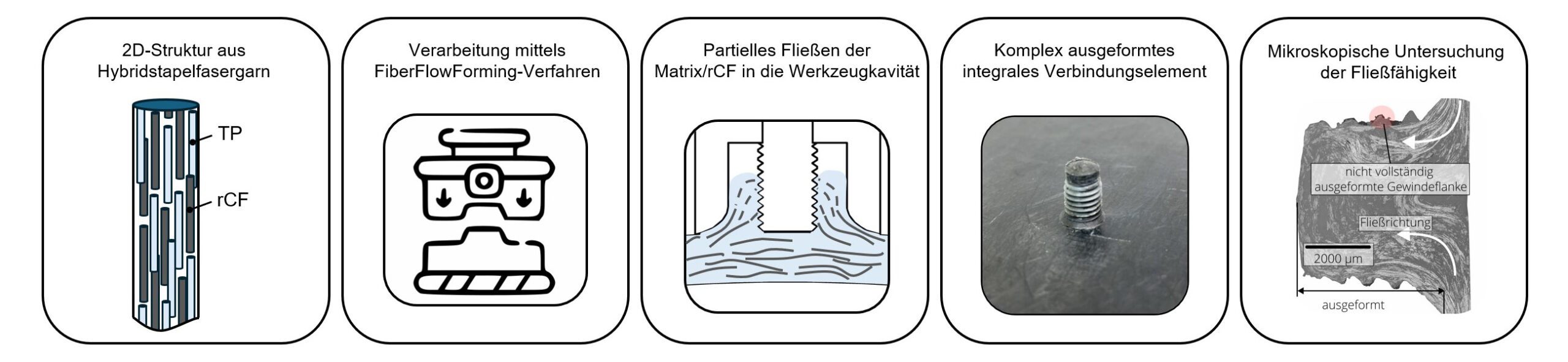
Manufacturing 3D-EPV-FKV and results of preliminary investigations
Outlook
The results of the research project can be transferred to all structures that benefit from seamless, structurally integrated connections with load path-oriented fiber alignment. Possible areas of application include shaft-hub connections and the connection of FRP structures without additional rivets or adhesive bonds. In addition, the results address key global developments and promote resource conservation, sustainability, and recyclability, thus making an important contribution to achieving the EU’s CO₂ neutrality targets.
The IGF project “Partially flowable textile constructions for 3D-EPVFKV” (IGF-No.: 01IF23608N) by the Institute of Textile Machinery and High Performance Material Technology (ITM) at TU Dresden is funded by the German Aerospace Center (DLR).
Contact:
Dresden University of Technology – Institute of Textile Machinery and High Performance Material Technology (ITM)
Dipl.-Ing. Lukas Möller, Scientific Assistant
+49 351 463-440 20
lukas.moeller1@tu-dresden.de
www.tu-dresden.de/mw/itm