Within several projects the Sächsisches Textilforschungsinstitut (STFI) develops textile technologies for high-performance fibers of finite length to provide high-performance semi-finished products made from secondary materials for industry.
Fiber materials from secondary cycles, such as recycled carbon fibers (rCF), and natural fibers (NF) generally have a finite fiber length, which leads to a reduced property profile in composite structures. Contrary to polymer fibers, these materials cannot be melt-spun and processed into new continuous fibers. rCF and NF are becoming more important as secondary materials in terms of sustainable materials and closed material flows, which necessitates the further development of existing technologies for high-performance textile structures.
More with less
In the field of natural fiber processing, STFI is conducting research within the HOTHEMP project to improve the mechanical properties of hemp bast laminates by chemical-thermal reduction of the biological matrix content. The lignin content in hemp bast is reduced to optimally exploit the performance potential of hemp fibers. The fibers, which are up to 3 m long, are further processed at the institute using warpknitting machine to warp knitted textiles. This allows mechanical characteristics in the range of conventional GRP laminates to be achieved.
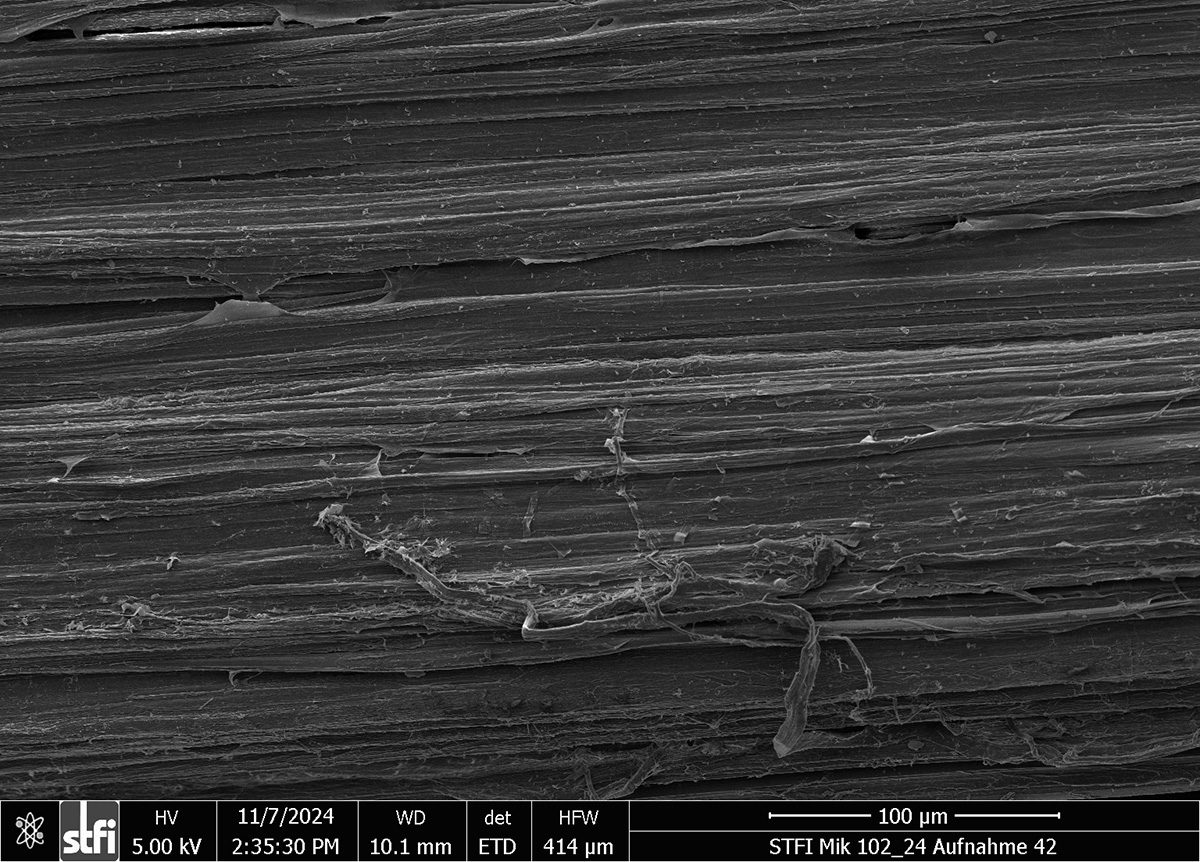
SEM image of a treated hemp bast fiber with low lignin content (© STFI)
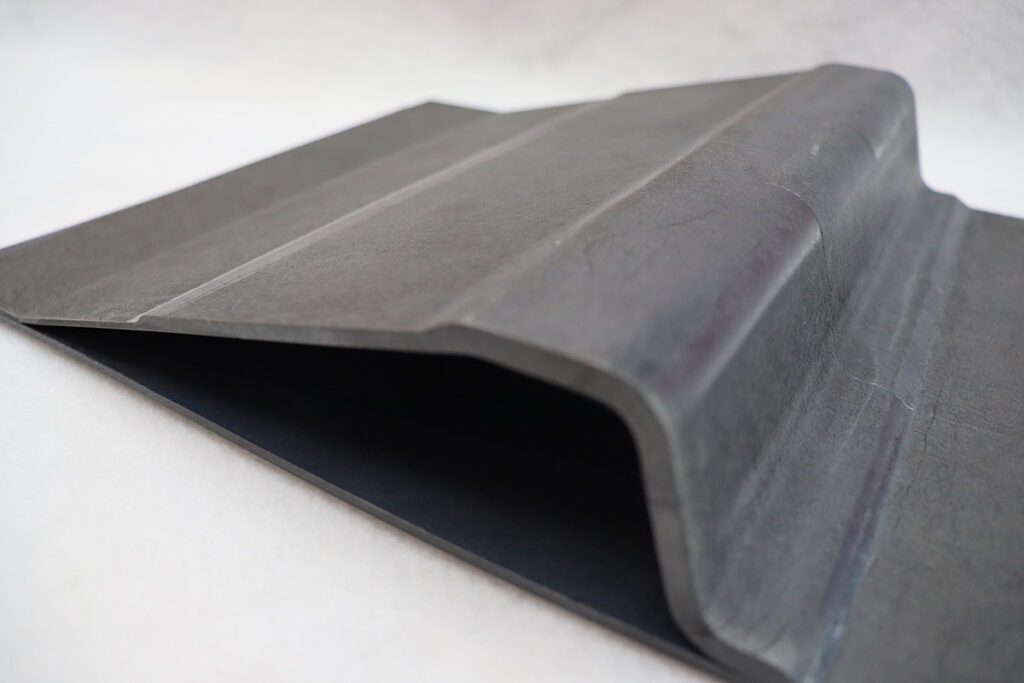
HIOS demonstrator with integrated Z-spar made of rC and PPS fibers (© STFI)
Promote through challenge
In the aviation sector, the high fire safety requirements pose an obstacle to the use of NFK. Current developments, such as those within the research project LUFTIFLEX, show that only a combination of fire-protected fibers and a fire-retardant matrix can meet the requirements for flexible laminate structures in aviation.
The performance level of textiles made from rCF in composite materials is increasing significantly because there is a growing trend towards using proprietary waste streams. In the HIOS project, continuous compression moulding technology was used for the first time to produce organo sheets of variable thickness from rC and PPS fibers across the entire width, which were additionally modified by local functionalisation consisting of TFP and AFP structures. This made it possible to locally increase the fiber volume content of 30 Vol.-% in nonwovenbased
laminates. Component demonstration using a twostage thermoforming process
was carried out on a damper flap box structure with integrated Z-spar.
In the HIPER project, the use of a stretching machine significantly improved fiber alignment in the semi-finished textile products. This led to a significant increase in fiber volume content to more than 40 Vol.-%, which is accompanied by a significant increase in stiffness and strength in the composite material. Researchers at STFI are working on the next stage of development, which has a target fiber volume content of 50 Vol.-% rCF. This should open new areas of application in aviation and the energy sector.
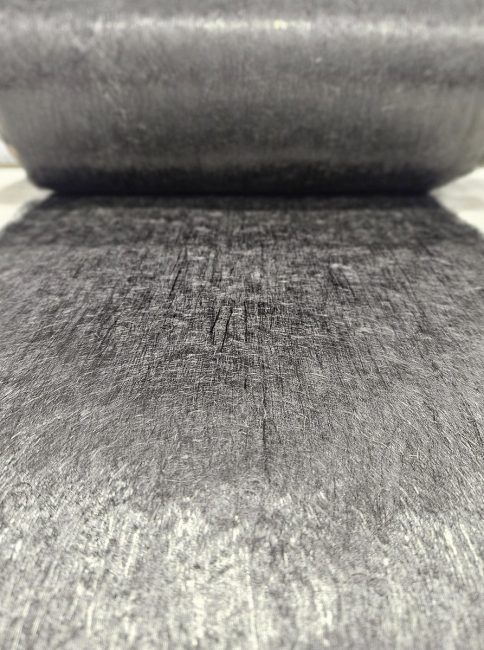
HIPER semi-finished product made of rCF with high fiber alignment (© STFI)
Ready for inventions
The STFI is a competent and globally leading development partner for the use of recycled fibers, particularly for composite applications. Semi-industrial plant capacities enable rapid transfer to industrial processes, from sampling to pilot series production.
Contact:
Sächsisches Textilforschungsinstitut e. V. (STFI)
Christopher Albe, Leader rCF & fiber composites
Phone: +49 371 52 74-241
E-Mail: christopher.albe@stfi.de
www.stfi.de