EcoRudder R&D project tests thermoplastic sandwich structures for aircraft construction
Thermoplastic honeycomb core sandwich structures can be processed efficiently and are also recyclable. These advantages are now to be exploited in the manufacture of components for aircraft construction.
Fiber composite sandwich construction has been established in aircraft construction for decades and is used, among other things, for control surfaces such as the rudder. It allows for the creation of very light yet highly rigid and strong structures.
However, to date, only thermosetting fiber composites in combination with a honeycomb core made of aramid paper have been used. The production of such components is complex and involves many manual steps.
Research is being conducted into the use of sustainable thermoplastic fiber composites to produce larger quantities and meet stricter requirements in terms of ecological footprint. These can also be processed in much more automated processes, thus enabling an increase in productivity for the manufacture of aircraft components.
Wanted: Best sandwich
The EcoRudder project, a subproject of the EU Clean Aviation research project FasterH2, has therefore set itself the goal of researching the use of thermoplastic sandwich structures for the rudder. The partners involved in the consortium have investigated the use of thermoplastic honeycomb core sandwich structures made of the high-temperature plastic PEI.
The honeycomb core developed by EconCore with a special hexagonal cell geometry is manufactured in a continuous process and covered with carbon fiber-reinforced sandwich face sheet layers. The pre-consolidated sandwich panels were then processed using the thermoplastic sandwich molding technology developed at Fraunhofer IMWS.
The thermoplastic sandwich is thermoformed in 3D according to the component contour, whereby the honeycomb core is retained and the load-bearing capacity of the sandwich is ensured. The honeycomb core is deliberately melted down in the edge areas. This allows tapered ramps to be created at the edges of the components, as required, for example, on the sandwich shells of the rudder.
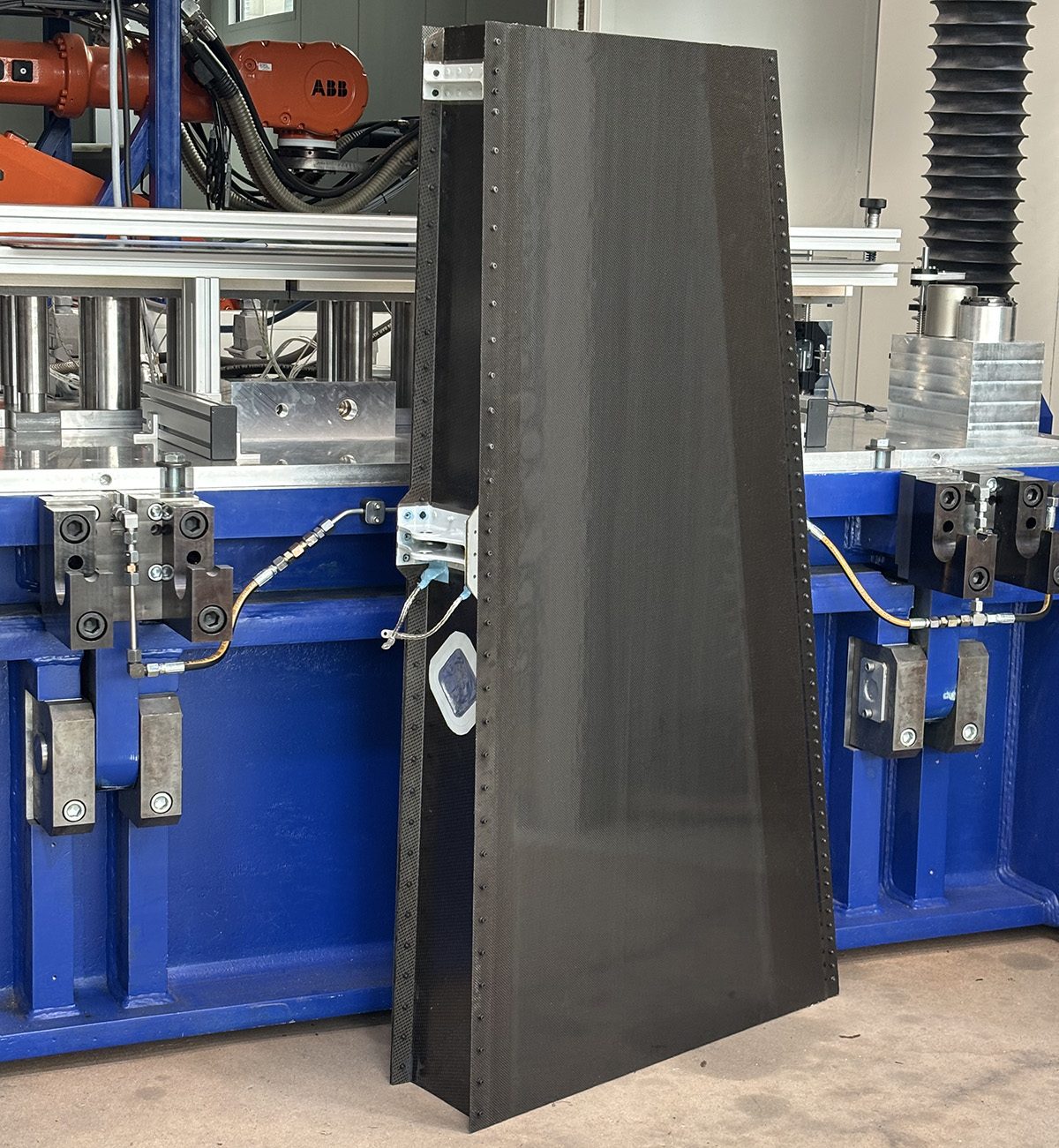
Rudder section demonstrator with thermoplastic sandwich shells (© Fraunhofer IMWS)
Practical test and demonstrator
The processing behaviour during edge forming was systematically investigated in laboratory tests. The process was then scaled up and a trial production facility was set up. This was used to form sandwich shells up to 1600 mm in length at the edge with a cycle time of a few minutes.
A prototype component segment of the rudder manufactured as part of the project demonstrates the potential of the developed sandwich technology. The demonstrator shows the processed thermoplastic sandwich shells on a segment
of the original load-bearing CFRP spar.
See for yourself
The Composite Sandwich Conference, which will take place again in Halle (Saale) on 5 and 6 May 2026, offers an opportunity for in-depth discussion of innovative composite sandwich technologies.
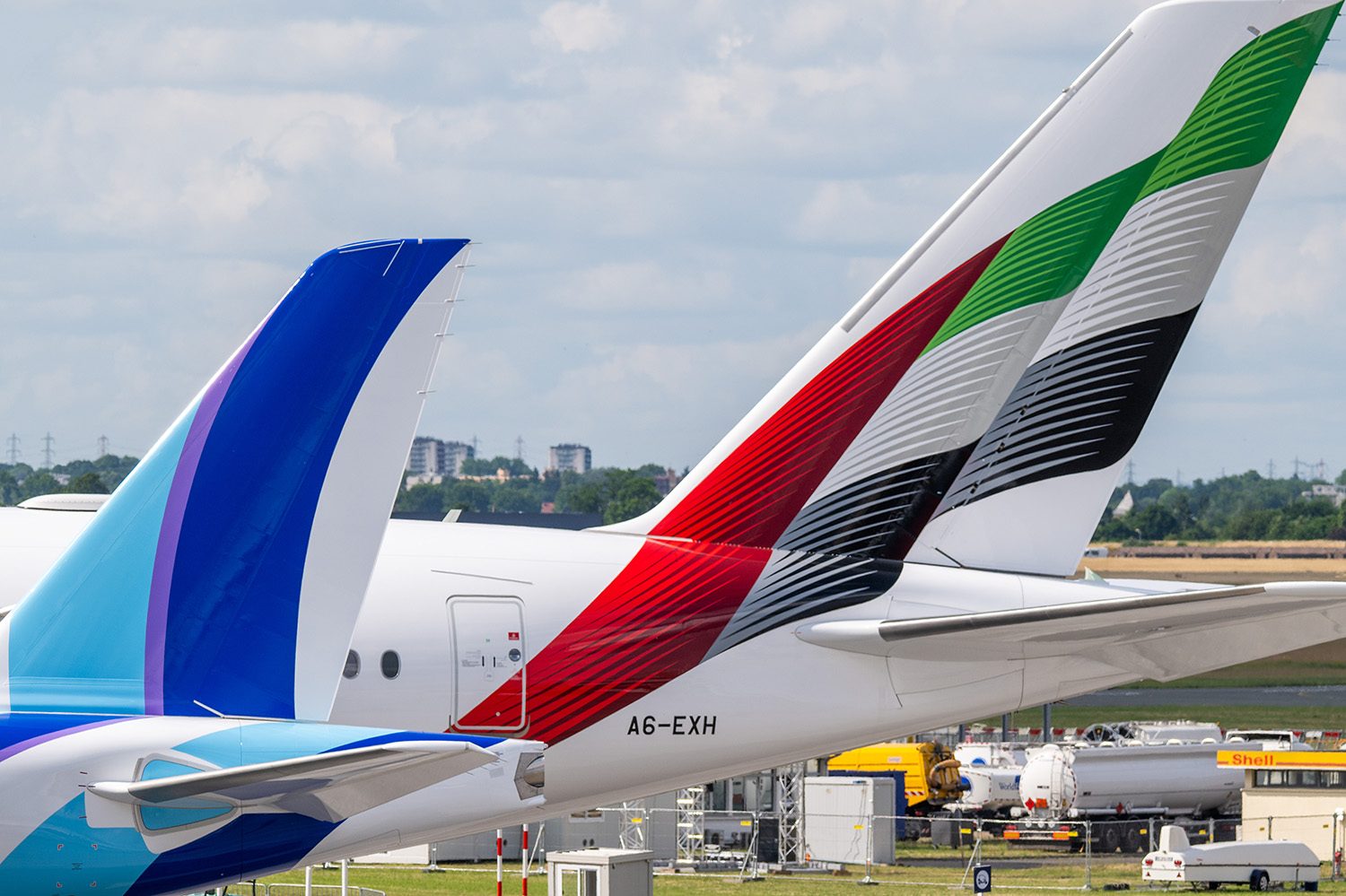
Lightweight sandwich construction on the rudder of the vertical tail plane (© Airbus SAS 2025)
Project partner: Airbus, Fraunhofer IMWS, EconCore N.V., DTU
Contact:
Fraunhofer Institute for Microstructure of Materials and Systems
IMWS, Halle/Saale
Dr.-Ing. Ralf Schlimper
Group Leader Assessment and Design of Composite Structures
Tel.: +49 345 55 89-263
Mobil: +49 160 99 02 67 46
ralf.schlimper@imws.fraunhofer.de
www.imws.fraunhofer.de