The JEC Innovation Award 2026 in the category “Automotive and Road Transportation – Process” was awarded to the mass-production-ready manufacturing process for structural thermoplastic battery housings. The award-winning exhibit will be showcased in March at the leading international trade fair JEC World in Paris.
In the award-winning project “GroKuBat – Large-scale production-ready plastic battery housing for mass production” the Department of Lightweight Structures and Polymer Technology at Chemnitz University of Technology collaborated with research and industry partners. Together, they used commercially available thermoplastic fiber composites (combined use of long and continuous fiber-reinforced thermoplastics) as an integral solution and adapted them for an automated production line suitable for large-scale series production. The aim was to functionally replace a metallic reference concept, without compromising functionality, while breaking new ground in manufacturing in order to improve the CO₂ balance across the entire life cycle.
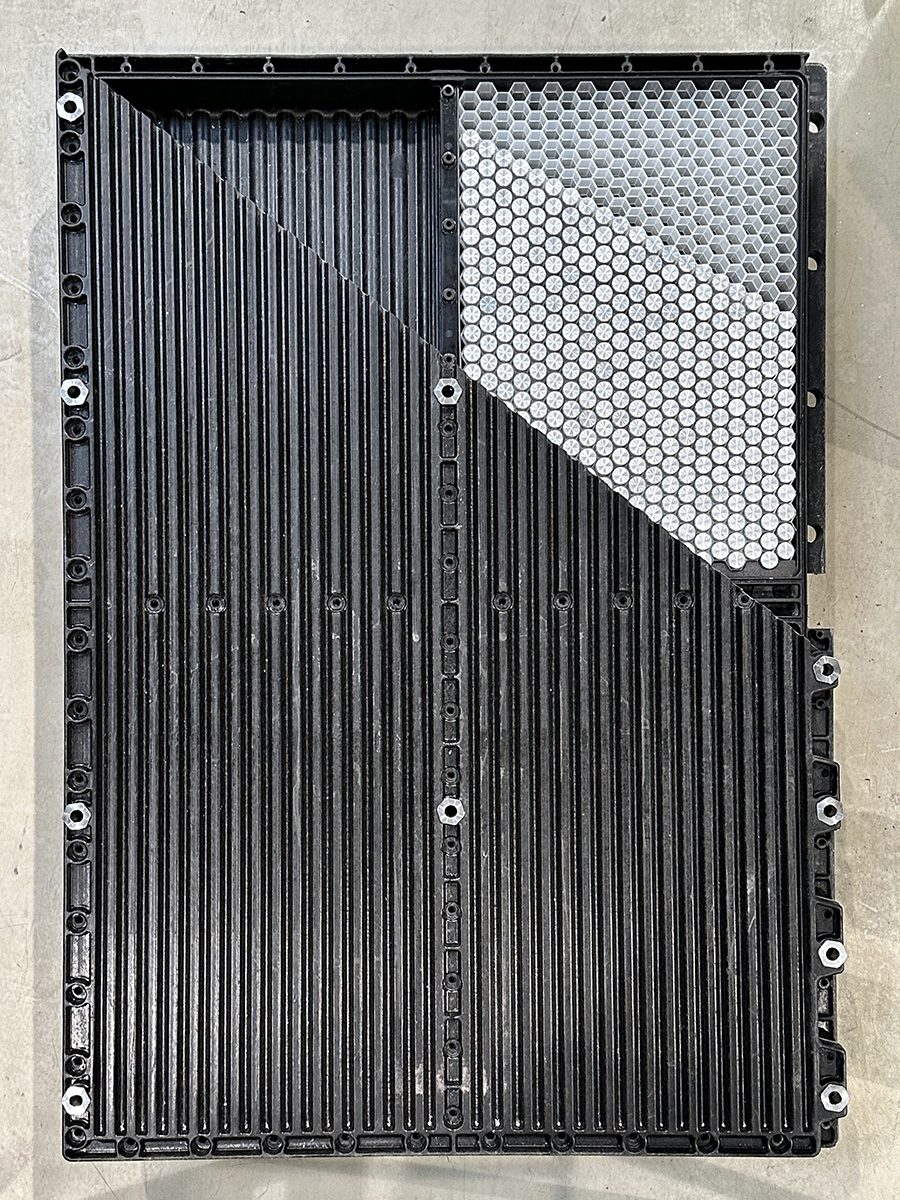
Developed thermoplastic traction battery housing with a view of the cell structure
Methodology and manufacturing concept
Continuous fiber reinforcement combined with a thermoplastic matrix allows for high specific stiffness with good energy dissipation. The core of the process is a manufacturing method based on compression molding, short-cycle tooling technology, and automated material feeding. This concept has been validated under near-series conditions. The production layout was designed for cycle time-optimized handling of large, waste-free rectangular semi-finished product formats.
Key findings
1. Crash performance: The thermoplastic FRP battery housings meet all requirements for structural integrity and energy absorption. Fiber orientation and local geometric adjustments were crucial for achieving the desired structural performance, verified through extensive testing, e. g. simulations and physical Euro NCAP pole impact tests.
2. Large-scale production capability: Material processing and flow are reliable. Simplifying the geometry and number of semi-finished products enabled the cost-effective series production of large structural thermoplastic battery boxes.
3. Cycle time: Production cycles are significantly less than two minutes per component, including the associated component demolding, which ensures high competitiveness compared to metal solutions.
4. CO₂ footprint: Life cycle assessment studies show CO₂ emissions to be approximately 25 % lower than for conventional metal housings. This is achieved through reduced component mass, lower energy consumption during production, and optimized recycling routes for thermoplastic composites.
5. Weight reduction: The developed battery housing has a mass that is approx. 15 % lower than the aluminum reference design. This has a direct positive impact on vehicle range and energy efficiency.
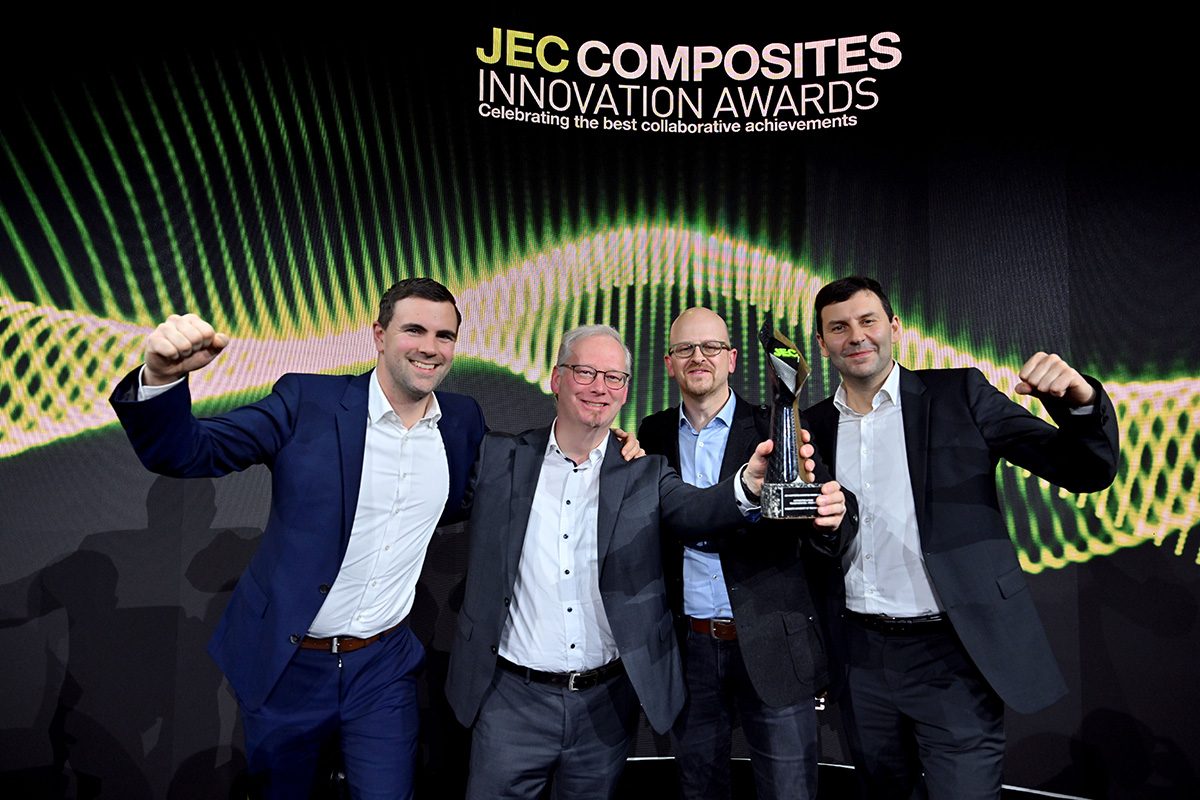
Great joy for the GroKuBat team about the JEC Award
Winner of the JEC Award
The successful project results show that long-fiber and continuous-fiber reinforced thermoplastic traction battery housings can meet all safety, sustainability, and cost-effectiveness requirements. The positive response and the JEC Innovation Award 2026 underscore the thematic relevance and innovative nature of the development approach.
We would like to thank the German Federal Ministry for Economic Affairs and Energy (BMWE) for its financial support for the research and development project within the funding guideline “New Vehicle and System Technologies” as well as our partners Mahle Filtersysteme (project coordinator), Formenbau GF, In2p, Gerlinger Industries, Wickert Maschinenbau, and Fraunhofer ICT.
Contact:
Chemnitz University of Technology, Department of Lightweight Structures and Polymer Technology
Frank Schettler
+49 371 531-389 24
frank.schettler@mb.tu-chemnitz.de
www.leichtbau.tu-chemnitz.de