Recyclable FRP structures and recycling strategies for vehicle applications

Project Objective:
The objective of the project is to develop sustainable and recyclable fibre-reinforced composite materials based on thermoplastic resin systems for applications in the automotive and aerospace industries. By enabling the chemical recyclability of these materials, both the fibres and the matrix can be recovered and reused, thereby establishing a closed-loop material cycle for high-performance composite materials.
Research Focus Areas:
Validation of the Chemical Recycling Process
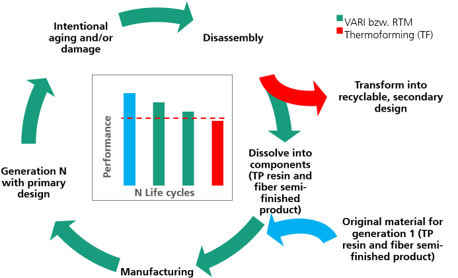
The project investigates and validates the process parameters required for the chemical recycling of thermoplastic fibre-reinforced composites. The objective is to recover both fibres and resin matrix with sufficient quality for reuse in VARI and RTM manufacturing processes (VARI – Vacuum Assisted Resin Infusion; RTM – Resin Transfer Moulding).
Sustainable Solvent Selection
A key focus of the project is the replacement of conventional, potentially hazardous solvents with an environmentally friendly alternative. The selected sustainable solvent must meet the requirements of the chemical recycling process while simultaneously reducing environmental impacts.
Material Characterisation and Structural Simulation
Material properties are evaluated over multiple recycling cycles. Fibre-reinforced composite structures are manufactured, characterised, artificially aged, chemically recycled, and subsequently reprocessed using the recovered fibres and matrix materials. The resulting material data serve as the basis for structural simulations aimed at assessing the performance and service life of the developed composite structures.
Environmental and Cost Assessment
To enable a comprehensive evaluation of the developed processes, Life Cycle Assessments (LCA) and Life Cycle Costing (LCC) analyses are conducted. These assessments investigate environmental and economic impacts, as well as the potential for reducing energy consumption and waste generation.
Second-Life Strategy for CFRP
Another research focus is the development of a second-life strategy for degraded carbon fibre-reinforced polymers (CFRP). Based on thermoplastic composite materials, concepts are being developed to facilitate material reuse, thereby reducing resource consumption and waste generation.
Project Partners:
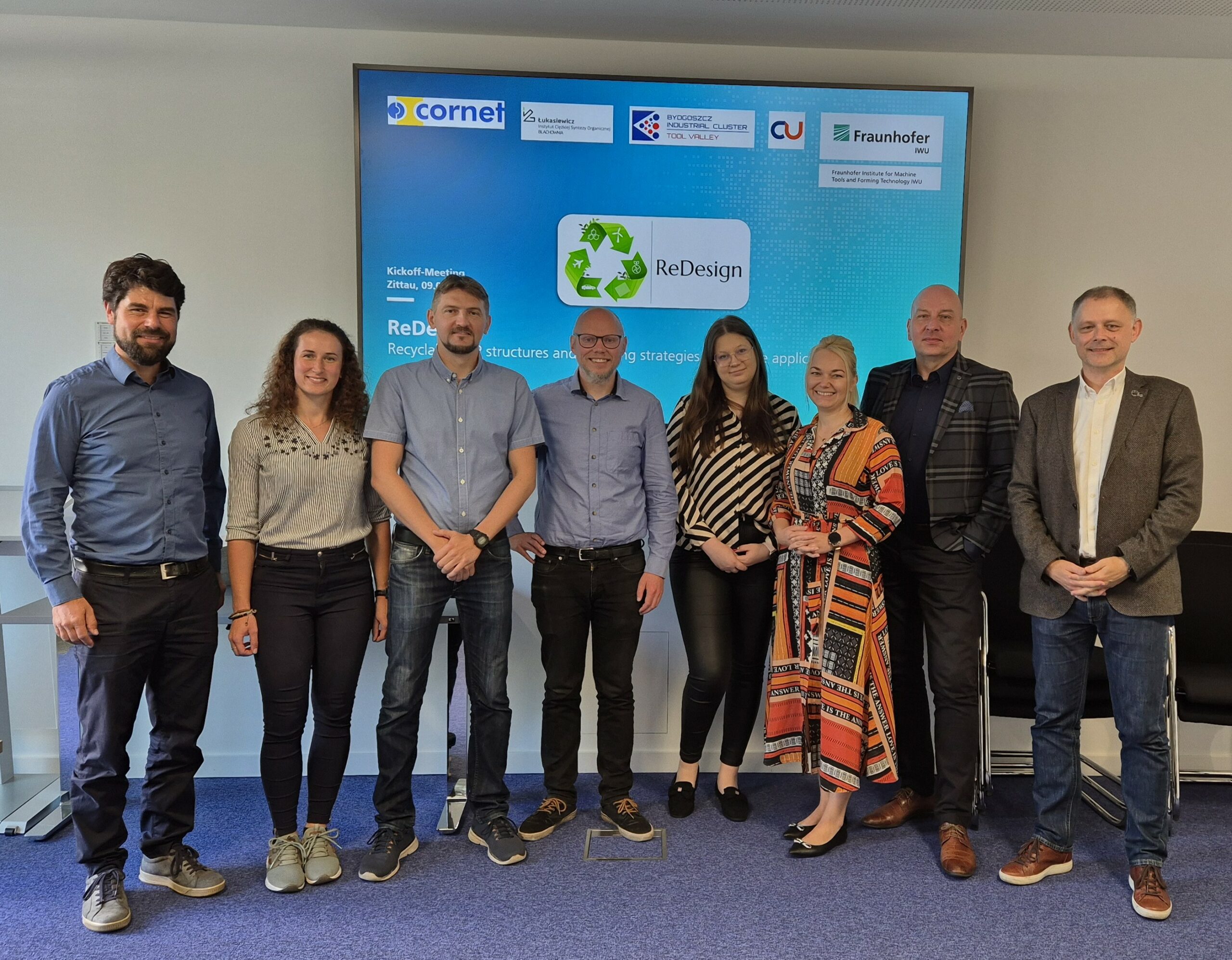
- Fraunhofer IWU (DE): Specimen Manufacturing (VARI / Thermoforming), Material Characterisation, Structural Simulation, Project Evaluation
- Composites United Leichtbau-Forschung gGmbH (DE): Project Management
- Bydgoszcz Industrial Cluster Tool Valley (POL): Environmental and Economic Assessment (LCA, LCC), Material Ageing
- The Lukasiewicz Research Network – Institute of Heavy Organic Synthesis “Blachownia” (POL): Chemical Recycling, Development of Environmentally Friendly Solvents
Project Website of Bydgoszcz Industrial Cluster Tool Valley
The project is co-financed by the German Federal Ministry for Economic Affairs and Climate Action (BMWK) within the framework of the CORNET Programme (CORNET Initiative – 37th Call for Proposals).